About Window & Door Certification
Window and door certification in the USA began in 1947, at a time when there was little regulation of the building industry. In that year, the American Architectural Manufacturers Association (AAMA) began to establish performance standards for fenestration products of all types. This quickly became an indispensable resource for architects, contractors and manufacturers seeking to standardize and guarantee product performance. Since that time, certification standards have become more stringent and testing protocols more rigorous. International collaboration has also helped improve and rationalize standards.
Product testing verifies the quality of fenestration and allows architects and home builders to make educated decisions on the doors and windows that best fit the needs of their building and location. It also provides an objective way of comparing the products of multiple manufacturers.
All windows and doors must comply with sections of the International Energy Conservation Code (IECC), International Building Code (IBC), the International Residential Code (IRC) and, in Florida, with the Florida Building Code (FBC).
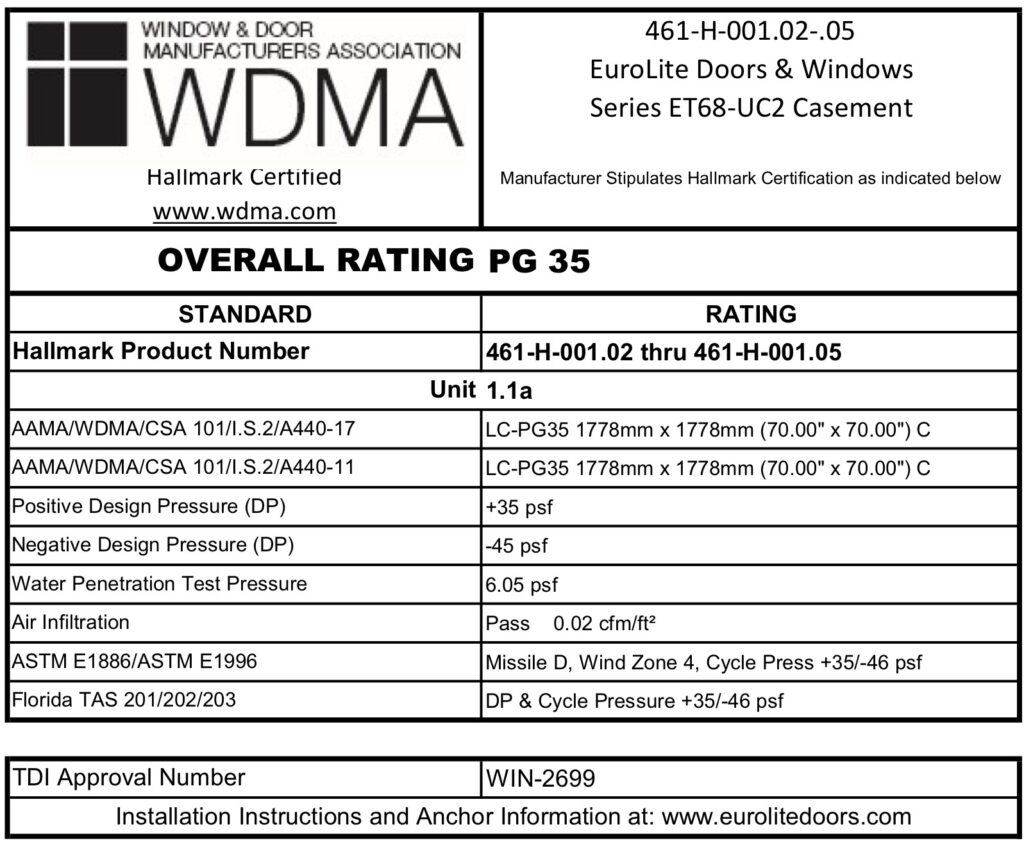
Certification information is specified on building plans and is verified to comply with the relevant building codes required to gain building approval. Building inspectors will also check that the windows and doors installed are those specified – this is why official NFRC and WDMA labels are affixed to each EuroLite unit and should not be removed until inspection is competed.
There are three performance categories to consider when choosing fenestration:
1) ENERGY. The National Fenestration Rating Council (NFRC) certifies Energy Performance ratings. Extensive testing is required to establish the energy transfer values for all parts of frames and sashes and for each glazing option. This includes the rating of each layer of glass, gas filled gap and spacer used. Certification requires physical testing of products by a 3rd party laboratory, as well as computer simulation to extrapolate those tests for every size and shape of unit offered. After final approval, a certification number is assigned and the products can then carry the official NFRC rating label.
2) STRUCTURAL. This includes air and water infiltration, structural integrity and forced entry resistance. Sample product is installed into wood, steel and concrete rough opening and then tested to AAMA/WDMA/CSA 101/I.S.2/A440 (also known as NAFS) or TAS 202 requirements. There are five sub-categories of structural performance:
a) Air Infiltration: The product is tested per ASTM E283 to determine the air leakage rate across the entire specimen.
b) Water Infiltration: Per ASTM E331 and ASTM E547 water penetration, by uniform static air pressure, ensures products do not let water into the interior of the building. This measures the competence of seals as well as the integrity of the entire product itself.
c) Structural Integrity: Testing per ASTM E330 determines the strength of fenestration, providing a rating of its ability to withstand a specific Design Pressure (DP). Testing measures elastic deformation at half DP and then at full DP. The unit is then tested to 1-1/2 times DP and then released. The longest unsupported span is examined to determine any permanent deformation. Both elastic deflection and permanent deformation results must fall within the accepted amount per the standard. Tests are performed with positive pressure and then with negative pressure.
d) Forced Entry: Testing establishes the ability of a unit to withstand an attempt to gain entry by force. The standard for windows is ASTM F588, swing doors ASTM F467 and sliding doors ASTM F842.
e) Operational Functionality: All products require auxiliary testing, which differs for each type of unit. For example, a side hinged door is tested to AAMA 920 and requires the door to be opened and closed from 25,000 to 500,000 times, depending on the exact class.
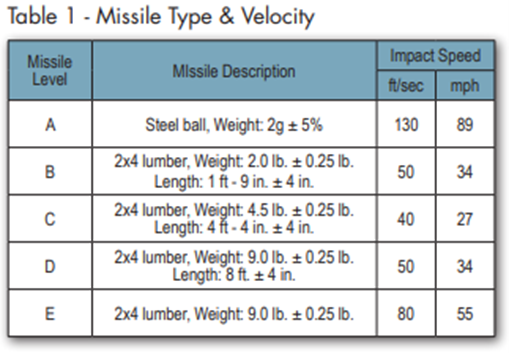
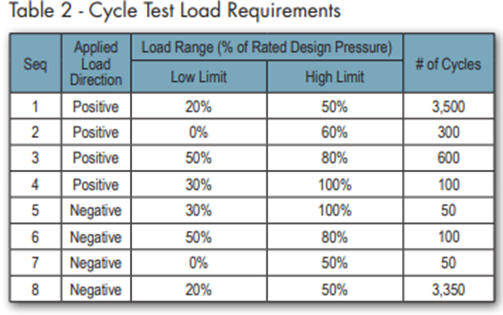
3) HURRICANE, The third type of testing is for High Velocity Hurricane Zones (HVHZ) which requires impact and cyclic testing for vulnerable areas like most of Florida and other coastal regions where hurricanes typically make landfall. This requires testing to ASTM E1886/E1996 and TAS 201/203 protocols. These simulate the rapid pressure changes that happen during a hurricane, as well as impact of windborne debris. For example, a 9lb 2×4 wooden post is shot out of a cannon at 34 mph to impact with the specimen multiple times in different places. A unit will pass this test if there is no tear or opening through which a 3” diameter sphere can pass. The unit is then pressure cycled 4500 times positive and 4500 times negative and examined to ensure there are no tears or openings.
After all testing is completed, the results are sent to a the WDMA (Hallmark) for review and approval. A certification number is then assigned and the products can be labeled with the product class and rating achieved.
Quality Assurance. In addition to the rigorous testing required, manufacturers are required to maintain a Quality Assurance Management System that meets the requirements of the 3rd party certification agencies. This ensures that all products produced are the same quality and standard as those that were certified. A 3rd party certification agency regularly inspects the manufacturing facilities and performs onsite audits of the Quality System and records, as well as inspecting products being made. This process is for both the NFRC and WDMA Hallmark certifications.
All of these tests are performed to protect the public health, safety and general welfare of the occupants of a building. It is also an objective means to evaluate the strength, durability and energy efficiency of the window or door products that you choose.
* On January 1, 2020, AAMA and IGMA (Insulating Glass Manufacturers Alliance) merged into one organization, the Fenestration and Glazing Industry Alliance, or FGIA.