
Ultimate Guide to Commercial Steel Doors in USA (2025)
Table of Contents
- Introduction: The Unsung Workhorse of US Businesses
- What Are Commercial Steel Doors in USA? (Featured Snippet)
- Why Steel is the Standard for Commercial Doors in the USA
- Benefit 1: Uncompromising Security and Impact Resistance
- Benefit 2: Critical Fire Life Safety and Code Compliance
- Benefit 3: Extreme Durability for High-Traffic Environments
- Benefit 4: Long-Term Cost-Effectiveness (Total Cost of Ownership)
- The Anatomy of a Commercial Steel Door: A Deep Dive
- Steel Gauge Explained: 16, 18, and 20 Gauge
- Understanding Door Cores: The Inside Story
- Comparison Table: Commercial Door Core Types
- Commercial Steel Frames: Welded vs. Knock-Down (KD)
- Hardware Preparations: The Key to Functionality
- People Also Ask: Quick Answers on Commercial Steel Doors
- Navigating US Standards: A Guide to Compliance
- Decoding Fire Ratings for Commercial Steel Doors (NFPA 80)
- ADA Compliance: Accessibility for All in the USA
- Key US Standards: ANSI, SDI, and UL
- A Buyer’s Guide to Specifying Commercial Steel Doors in the USA
- Interior vs. Exterior: Key Differences
- US Climate Zone Considerations (Thermal Breaks)
- Checklist: How to Specify Your Commercial Door Order
- Installation: Why This is a Job for US Professionals
- In-Depth Q&A on Commercial Steel Doors in USA
- Conclusion: The Smart Investment for Your US Facility
1. Introduction: The Unsung Workhorse of US Businesses
Walk through any school, hospital, warehouse, or office building in the United States, and you will pass through dozens of steel doors without a second thought. These doors are the unsung workhorses of the built environment. They are pushed by gurneys, kicked by carts, and subjected to thousands of opening-and-closing cycles every single day. While a residential door prioritizes aesthetics, a commercial door has a much more serious job: to provide security, safety, and durability under constant, heavy use. This is why when you’re sourcing commercial steel doors in USA, you’re not just buying a door; you’re investing in a critical piece of building infrastructure.
From my experience specifying openings for countless US commercial projects, I’ve seen firsthand how the right door can protect assets and save lives, while the wrong one can lead to failed inspections, security breaches, and constant maintenance headaches. The terminology—gauge, fire-rating, KD frames, mortise locks—can be intimidating. This comprehensive guide is designed to cut through that complexity, providing you with the practical, verifiable information needed to select the right commercial steel doors for your American business, ensuring compliance, security, and long-term value.
2. What Are Commercial Steel Doors in USA? (Featured Snippet)
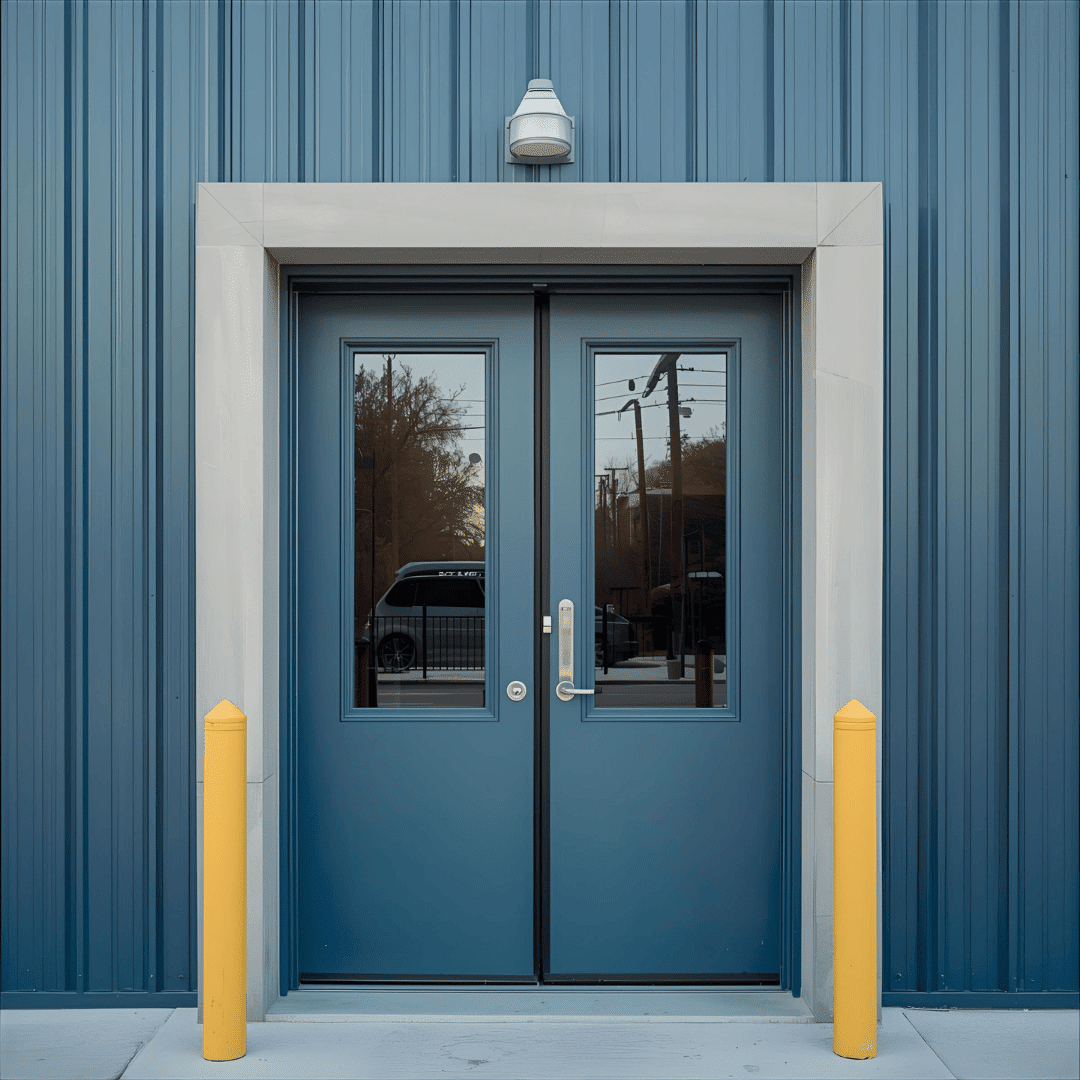
Commercial steel doors in USA are heavy-duty door systems designed for high-traffic, industrial, or public-facing buildings. Often called “hollow metal doors,” they are prized for their durability, security, and critical fire-resistance properties, making them a standard for US building codes in schools, hospitals, and offices.
3. Why Steel is the Standard for Commercial Doors in the USA
Business owners, facility managers, and general contractors in the United States choose steel for a precise set of reasons that directly impact a building’s safety and budget.
Benefit 1: Uncompromising Security and Impact Resistance
This is the most obvious benefit. A commercial steel door, constructed from 16, 18, or 20 gauge steel, is an exceptionally formidable barrier.
- Forced Entry: Unlike wood or aluminum, a heavy-gauge steel door and frame assembly is highly resistant to being pried, kicked, or drilled.
- Impact Resistance: In a warehouse, hospital, or factory, doors are constantly hit. From my experience, a wood door would be splintered and destroyed within months in these environments. A steel door can take significant impacts from carts, pallets, and equipment and remain fully functional.
Benefit 2: Critical Fire Life Safety and Code Compliance
This is, by far, the most important function of many commercial steel doors in USA. Steel is inherently fire-resistant. When built as a “fire-rated assembly,” a steel door is designed to compartmentalize a building, blocking the spread of smoke and flames for a specific period—from 20 minutes to 3 hours.
As specified by the National Fire Protection Association (NFPA), these doors are legally required in stairwells, elevator lobbies, and any wall that is part of a building’s “fire-rated” design. A properly installed, labeled, and functioning fire door is a non-negotiable part of any US building’s life-safety system, saving both lives and property.
Benefit 3: Extreme Durability for High-Traffic Environments
Steel does not have the problems that plague other materials.
- It doesn’t warp with humidity changes like wood.
- It doesn’t crack or bow from temperature swings.
- It doesn’t rot or delaminate when exposed to moisture.
- It doesn’t get eaten by termites or other pests.
This stability means the door continues to hang, latch, and seal correctly for decades, even in the most demanding US locations, from a high-humidity kitchen exit to a high-use school gymnasium.
Benefit 4: Long-Term Cost-Effectiveness (Total Cost of Ownership)
While a heavy-duty commercial steel door might have a higher initial purchase price than a lightweight alternative, its Total Cost of Ownership (TCO) is dramatically lower. A residential-grade door in a commercial setting might last 1-2 years before it fails. A properly specified commercial steel door can last 30 years or more. When you factor in the avoided costs of replacement, constant maintenance, and potential security failures, steel is by far the most economical choice over the life of your building.
4. The Anatomy of a Commercial Steel Door: A Deep Dive
What you see on the surface is just a painted slab. The performance of commercial steel doors in USA is dictated by their internal construction. The industry term you’ll hear from architects and contractors in the US is “hollow metal door” (HMD).
Steel Gauge Explained: 16, 18, and 20 Gauge
In the steel industry, the terminology is counter-intuitive: the lower the gauge number, the thicker, heavier, and stronger the steel.
- 20 Gauge (Standard Duty): This is the lightest-duty commercial grade. You’ll find it in light-traffic interior applications like office doors, hotel room entries, or utility closets where security and impact risk are low.
- 18 Gauge (Heavy Duty): This is the “workhorse” of the US commercial industry. It provides the perfect balance of durability, security, and cost. It’s the standard choice for most school, hospital, and high-traffic office building entryways.
- 16 Gauge (Extra Heavy Duty): This is for maximum security and durability. From my experience, you specify 16-gauge for high-security areas (banks, data centers), manufacturing plants, and exterior doors in high-abuse or high-wind locations.
Understanding Door Cores: The Inside Story
The term “hollow metal” is a bit of a misnomer. The inside of the door is filled with a core material that dictates its insulation, fire-rating, and acoustic properties.
- Honeycomb: A kraft paper or cardboard honeycomb mesh bonded to the steel skins. It’s the lightest and most economical core, good for basic interior doors where insulation and sound control are not priorities.
- Polystyrene (EPS): A solid, rigid foam board (like Styrofoam) that is cut and placed inside the door. This core adds a good level of thermal insulation (an R-value around R-7) and provides decent sound dampening.
- Polyurethane (Injected): This is the high-performance option. The foam is injected as a liquid and expands to fill 100% of the door’s internal cavity, bonding directly to the steel skins. This creates an incredibly strong, rigid door with the highest insulating R-value (R-12+), making it ideal for exterior doors in cold US climates.
- Steel-Stiffened: This core consists of vertical steel ribs or channels welded inside the door, with the cavities often filled with insulation (like fiberglass). This is the most durable, most secure core, designed for maximum-impact or high-security applications.
Comparison Table: Commercial Door Core Types
| Core Type | Primary Use | Insulation (R-Value) | Sound Control (STC) | Fire-Rated? |
| Honeycomb | Light-duty interior (offices) | Low (R-1 to R-2) | Low (STC 30-35) | Yes |
| Polystyrene | Standard interior/exterior | Good (R-7 to R-10) | Good (STC 35-40) | Yes |
| Polyurethane | Exterior, cold climates | Excellent (R-12+) | Excellent (STC 38-42) | Yes |
| Steel-Stiffened | Maximum security, high-abuse | Varies (with fill) | Varies | Yes |
Commercial Steel Frames: Welded vs. Knock-Down (KD)
The door is only half the assembly; the steel frame is just as important.
- Welded Frames: The frame corners (the head and jambs) are mitered and welded together at the factory into a single, rigid unit. These are stronger and are typically set in place during new construction before the drywall or masonry walls go up.
- Knock-Down (KD) Frames: These arrive in three separate pieces (head, hinge jamb, strike jamb) and are assembled and anchored into the existing “rough opening.” KD frames are the standard for interior applications and retrofits into existing drywall.
Hardware Preparations: The Key to Functionality
Commercial doors are almost always ordered with “preps” (pre-cut holes, reinforcements, and mortises) for specific hardware. This is not like a residential door. The hardware is a key part of the specification.
- Hinges: Typically 4.5″ heavy-duty butt hinges.
- Locksets: Prepped for either a Cylindrical Lock (a standard “lever” handle) or a heavy-duty Mortise Lock (a large, rectangular lock body that fits in a pocket, or mortise, in the door edge).
- Door Closers: A reinforced plate is welded inside the top of the door to provide a solid mounting point for an overhead door closer.
- Exit Devices (Panic Bars): For any door designated as an “egress” or “exit” in a public space, it will be prepped for a panic bar.
5. People Also Ask: Quick Answers on Commercial Steel Doors
- What is the standard size of a commercial steel door in the USA?The most common size by far is 3’0″ wide by 7’0″ high, which is expressed in industry terms as “3070” (three-oh, seven-oh). Other common sizes are 3068 (3’0″ x 6’8″) and 6070 (a 6’0″ x 7’0″ double door).
- How thick is a standard US commercial steel door?The industry standard thickness for almost all commercial steel doors in the United States is 1 3/4 inches.
- Are all commercial steel doors fire-rated?No, but they can be. A door must be specifically ordered as part of a fire-rated assembly (door, frame, and hardware) to be compliant. A fire-rated door will have a permanent, non-removable metal label (from a testing agency like UL) on the hinge-side edge.
- What is a “hollow metal door” (HMD)?”Hollow metal” is simply the US industry and architectural term for a commercial steel door and/a steel frame. If you’re talking to a supplier or architect, they will almost always use the term “hollow metal door” or “HMD.”
6. Navigating US Standards: A Guide to Compliance
This section is for informational purposes and not legal advice. Always consult your local Authority Having Jurisdiction (AHJ) or code official.
Decoding Fire Ratings for Commercial Steel Doors (NFPA 80)
A fire-rated door’s job is to contain a fire to one “compartment” of a building for a set time.
- The Rating: You’ll see ratings like 20-min, 45-min, 60-min, 90-min (1.5-hr), and 3-hr.
- The Rule: The door’s rating is typically 3/4 of the wall’s rating. For example, a 2-hour rated stairwell wall will require a 90-minute rated door.
- The Assembly: This is a critical point: the entire assembly must be rated. This includes the door, the frame, the hinges, the latch, and the closer. Using a non-rated hinge on a 90-minute door invalidates its rating.
ADA Compliance: Accessibility for All in the USA
The Americans with Disabilities Act (ADA) sets standards for accessibility in all US public accommodations. For doors, this means:
- Clear Width: The door must provide at least 32 inches of clear passage width when open to 90 degrees.
- Hardware: Hardware must be operable with one hand and minimal force (i.e., a lever handle, not a round knob) and be mounted no higher than 48 inches from the floor.
- Thresholds: Thresholds cannot be higher than 1/2 inch.
- Bottom Surface: The bottom 10 inches of the door must be a smooth, kick-plate-ready surface.
Key US Standards: ANSI, SDI, and UL
When shopping, you’ll see these acronyms. They are your mark of quality.
- ANSI (American National Standards Institute): Sets the performance standards for doors and hardware.
- SDI (Steel Door Institute): The leading US trade association that sets the manufacturing and performance standards. According to the SDI’s technical documents, their standards are the benchmark for quality and testing in North America.
- UL (Underwriters Laboratories): An independent testing lab that certifies doors and hardware for safety, especially for fire ratings. The “UL” label on your door is the proof that it meets the required standard.
7. A Buyer’s Guide to Specifying Commercial Steel Doors in the USA
Specifying the right door requires thinking about its specific job.
Interior vs. Exterior: Key Differences
- Interior Doors: The primary concerns are traffic flow, fire-rating, and acoustics. An 18- or 20-gauge door with a honeycomb or polystyrene core is typically sufficient.
- Exterior Doors: Security and weather-resistance are paramount.
- Steel: Must be Galvannealed (A60) or Galvanized (G90). This is a zinc-coating process that prevents rust. Using a non-galvannealed “primer-painted” door on an exterior is a costly mistake that I’ve seen lead to total failure in just a few years.
- Core: Must be polyurethane for maximum insulation (R-value) to prevent energy loss.
US Climate Zone Considerations (Thermal Breaks)
A door for a building in Miami, Florida, is different from one for a building in Minneapolis, Minnesota.
- Cold Climates (North US): You must specify a thermally-broken frame. This is a frame with a non-conductive material separating the interior and exterior metal, preventing frost and condensation from forming inside your building. Pair this with a polyurethane-core door for a high R-value assembly.
- Coastal Climates (Southeast US): Corrosion resistance is the top priority. A galvannealed (A60) steel finish is the minimum. In high-wind, hurricane-prone areas, you must also look for doors and frames with a specific “impact-rated” or “hurricane-rated” designation to comply with local codes.
Checklist: How to Specify Your Commercial Door Order
- [ ] Opening Size: Get the “call-out” size (e.g., 3070) and verify the “rough opening” in the wall.
- [ ] Wall Construction: Is the frame for a new masonry wall or an existing drywall wall?
- [ ] Handing: Which way does the door swing? (e.g., Left-Hand Reverse, Right-Hand). This is critical and a common error.
- [ ] Fire Rating: What rating is required by the code for this location? (e.g., None, 45-min, 90-min).
- [ ] Door Specifications: Specify Gauge (e.g., 18), Core (e.g., Polystyrene), and Finish (e.g., Galvannealed A60).
- [ ] Frame Specifications: Specify Type (e.g., KD or Welded), Gauge (e.g., 16), and Jamb Depth (to match the wall thickness).
- [ ] Hardware Preps: List the exact hardware to be used (e.g., Mortise lock, closer, panic bar).
8. Installation: Why This is a Job for US Professionals
This is not a DIY job. I cannot stress this enough. A commercial steel door is heavy, and its installation is a matter of precision and code compliance.
- Fire-Rated Assemblies: An improperly installed fire door (e.g., wrong gaps around the door, non-compliant hardware, or a frame that isn’t plumb) is not a fire door. It will fail inspection and, more importantly, it will fail in a fire. This creates a massive legal liability for the building owner.
- Functionality: If the heavy steel frame is not installed perfectly plumb, level, and square, the door will not swing or latch correctly. This will lead to premature wear on the hardware and a door that is a constant source of frustration.
- Specialized Tools: Installation requires specialized tools for anchoring the frame to steel studs, concrete, or masonry.
Always use a general contractor or a specialized Division 8 (Openings) installer to ensure your commercial steel doors in USA are installed safely and correctly.
9. In-Depth Q&A on Commercial Steel Doors in USA
- Q1: What’s the real-world difference between 16, 18, and 20 gauge steel?It’s a measure of thickness and dent resistance. 20-gauge is 0.036 inches thick. 18-gauge is 0.048 inches (about 33% thicker than 20-ga). 16-gauge is 0.060 inches (about 25% thicker than 18-ga). That extra thickness provides a significant, noticeable jump in dent resistance and security. For most applications, 18-gauge is the “sweet spot.”
- Q2: What does “galvannealed” (A60) mean?This is a heat and chemical process that fuses a zinc-iron alloy coating to the steel. Unlike basic galvanizing (G90), which leaves a spangled finish, galvannealing (A60) creates a matte-gray, “ready-to-paint” surface. It is the superior, standard finish for exterior commercial doors because it provides excellent rust protection and a perfect surface for paint to adhere to.
- Q3: How do I determine the “handing” of my commercial door?This is the most common and costly ordering mistake. To find the handing, stand on the “secure” side of the door (the side you would use a key on, or the “push” side of a panic-exit door). Face the door. If the hinges are on your left and the door swings away from you, it’s a Left Hand (LH). If the hinges are on your right and it swings away, it’s a Right Hand (RH). If it swings toward you, it’s a “reverse” (e.g., LHR, RHR).
- Q4: What’s the difference between a mortise lock and a cylindrical lock?A cylindrical lock is the most common type, where the lock chassis is installed through a round hole drilled in the door’s face. A mortise lock is a heavy-duty lockset that fits into a large, rectangular pocket (a mortise) cut into the edge of the door. Mortise locks are more secure, more durable, and typically found in high-use or high-security commercial applications like hospital or school entrances.
- Q5: What is an STC rating on a commercial door?STC stands for Sound Transmission Class. It’s a rating that measures how well a door assembly blocks airborne sound. A standard hollow metal door might have an STC of 30-35. For a private office, conference room, or clinic, you would specify a special “sound-rated” door with an STC of 40-50+ to ensure speech privacy.
10. Conclusion: The Smart Investment for Your US Facility
A commercial steel door is one of the most critical and hardest-working components in your facility. It is a long-term asset that, when specified correctly, pays dividends for decades in security, safety, legal compliance, and low maintenance.
By focusing on the correct gauge for your application, the right core for your climate, and the precise hardware for your function, you are not just buying a door; you are investing in the long-term integrity, safety, and efficiency of your facility.
When you’re ready to explore robust, high-performance entry solutions that meet these exacting standards, we invite you to discover our range of premium commercial steel doors.